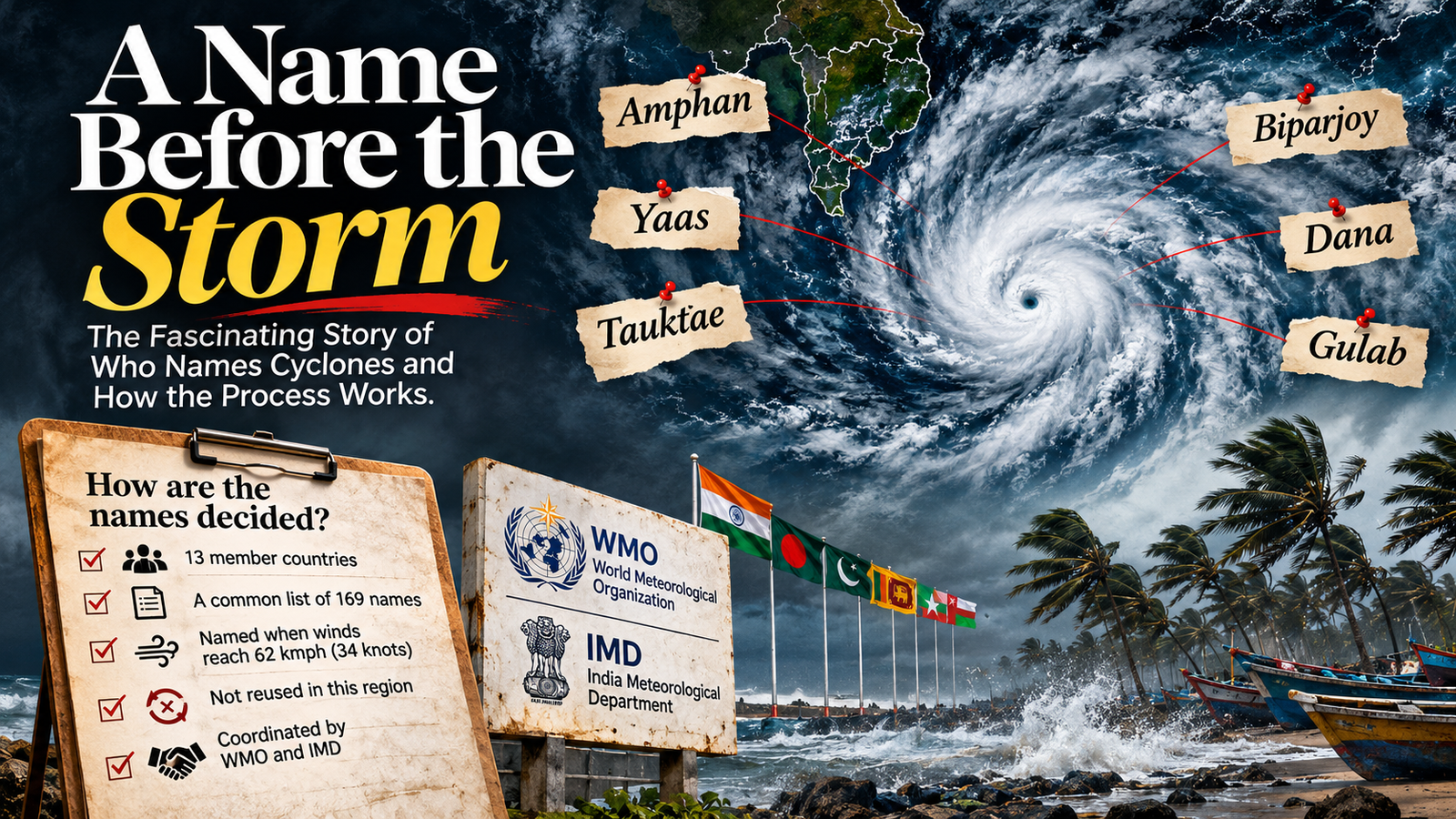
From Amphan and Yaas to Tauktae and Dana, the names of cyclones often become familiar long before their destructive winds reach the coastline. But who chooses these names? Is there a scientific reason behind them, and how does a storm acquire an identity? Behind every cyclone name lies an organised international system of cooperation, cultural representation and disaster preparedness.
When a cyclone begins gathering strength over the sea, weather agencies start monitoring its movement, scientists analyse its intensity, and coastal communities prepare for possible landfall. Soon, the storm makes headlines, but alongside its wind speed and projected trajectory, another detail catches public attention: its name- Amphan. Tauktae. Yaas. Biparjoy. Dana.
These names may sound like ordinary words, but each carries a story of international participation. Interestingly, the names of cyclones are not selected by meteorologists sitting in a control room after a storm develops. They are part of a predetermined naming system in which countries contribute names well before the storms emerge.
Why Does a Storm Need an Identity?
The practice of naming cyclones is rooted in a simple but important principle: effective communication can save lives. Imagine two tropical storms developing simultaneously over the ocean. Communicating warnings using only geographical coordinates, technical descriptions or numerical identifiers could create confusion among meteorologists, disaster management authorities, media organisations and the public.
A distinctive name makes it easier to identify a particular storm, circulate warnings, maintain records and communicate potential threats to vulnerable communities. In a country like India, where millions of people live along vulnerable coastal regions, timely and understandable weather information is particularly important. A cyclone warning must reach fishermen, coastal residents, government agencies and emergency responders without ambiguity. Thus, naming is not merely a matter of convenience. It is an important part of public communication and disaster preparedness.
The International Committee Behind the Names
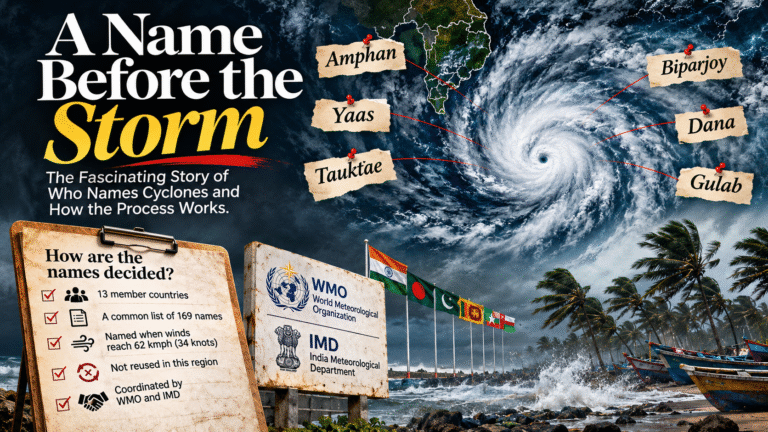
Contrary to popular belief, India does not independently decide the names of cyclones affecting its coastline. The responsibility is part of an international arrangement coordinated through the World Meteorological Organization (WMO) and the United Nations Economic and Social Commission for Asia and the Pacific (UNESCAP). For the North Indian Ocean region, the WMO/ESCAP Panel on Tropical Cyclones oversees the naming arrangement. It consists of 13 member countries: Bangladesh, India, Iran, Maldives, Myanmar, Oman, Pakistan, Qatar, Saudi Arabia, Sri Lanka, Thailand, the United Arab Emirates and Yemen. Each participating country contributes names to a common list. This means that a cyclone affecting India may carry a name suggested by another country in the region. For instance, Tauktae was contributed by Myanmar, Yaas by Oman, Gulab by Pakistan, Biparjoy by Bangladesh, Dana by Qatar and Amphan by Thailand. It is an interesting example of how countries with different languages, cultures and geographical identities participate in a shared scientific and disaster-management mechanism.
From a List of Names to a Powerful Storm
The naming process begins long before a cyclone takes shape. Under the North Indian Ocean system, each of the 13 member countries contributed 13 names, creating a list of 169 names. These names are arranged in a predetermined sequence and are used as qualifying cyclones develop. However, not every weather disturbance receives a name. The India Meteorological Department (IMD), which functions as the Regional Specialised Meteorological Centre (RSMC) for the North Indian Ocean, monitors tropical cyclone activity over the Bay of Bengal and Arabian Sea. When a system develops into a cyclonic storm with maximum sustained surface winds reaching at least 34 knots, approximately 62 kmph, it receives a name from the approved list. The names themselves are subject to certain guidelines. They should be short, easy to pronounce, culturally acceptable and neutral in terms of religion, politics and gender. They should not hurt the sentiments of any community or carry offensive meanings. In other words, naming a cyclone involves more consideration than simply finding a catchy word.
India’s Meteorological Responsibility
India occupies a significant position in this regional arrangement through the India Meteorological Department. The IMD’s Regional Specialised Meteorological Centre in New Delhi monitors cyclone development, forecasts their movement and intensity, and issues warnings and advisories for the North Indian Ocean region. The regional naming arrangement began in September 2004, when the first named cyclone under the system was Onil, which developed over the Arabian Sea. In April 2020, a fresh list of 169 names was introduced, incorporating contributions from all 13 participating countries. This makes India’s role particularly important, not only in monitoring cyclones but also in coordinating weather information across the region.
Can a Cyclone’s Name Be Used Again?
In the North Indian Ocean, a cyclone’s name is not reused once it has been assigned. The name is considered exhausted from the list, irrespective of how destructive the cyclone eventually becomes. This practice differs from that followed in the Atlantic Ocean, where tropical cyclone names are generally reused through rotating lists. However, names associated with exceptionally destructive storms can be permanently retired. Hurricane Katrina, which devastated parts of the United States in 2005, and Hurricane Maria in 2017 are notable examples of retired names. The difference highlights how cyclone naming practices can vary between meteorological regions while serving the same fundamental purpose.
Does the Name Reveal the Cyclone’s Intensity?
Despite the attention given to cyclone names, they have absolutely no scientific connection with a storm’s destructive potential. A cyclone named Dana is not necessarily weaker than one named Amphan. Its actual intensity and impact depend on several meteorological and geographical factors, including wind speed, rainfall, storm surge, direction of movement, landfall location and the vulnerability of the affected population. A name provides an identity; scientific observations determine the danger. This distinction is important because public attention sometimes focuses more on a cyclone’s unusual or unfamiliar name than on the actual warnings issued by meteorological agencies.
More Than a Name: A Symbol of Regional Cooperation
Perhaps the most remarkable aspect of cyclone naming is what it represents beyond meteorology. Cyclones do not recognise political boundaries. A storm developing over the Bay of Bengal can threaten the coastlines of multiple countries, making regional cooperation essential for forecasting, preparedness and disaster response. The naming system brings together 13 countries under a common framework, allowing them to contribute to a shared mechanism for identifying and communicating tropical cyclones. When an Indian coastline faces a cyclone carrying a name suggested by Oman, Thailand or Bangladesh, it reflects a broader reality: natural disasters require cooperation beyond national borders. The next time a cyclone appears in the headlines, its name might seem like just another word accompanying a weather forecast. But behind that word is a carefully organised international process involving science, diplomacy and public safety. A cyclone may be born over the ocean, but its name is born through international cooperation.
About the Author