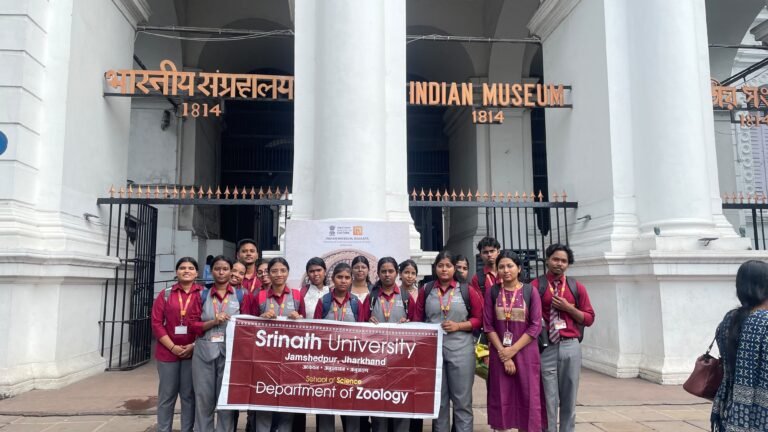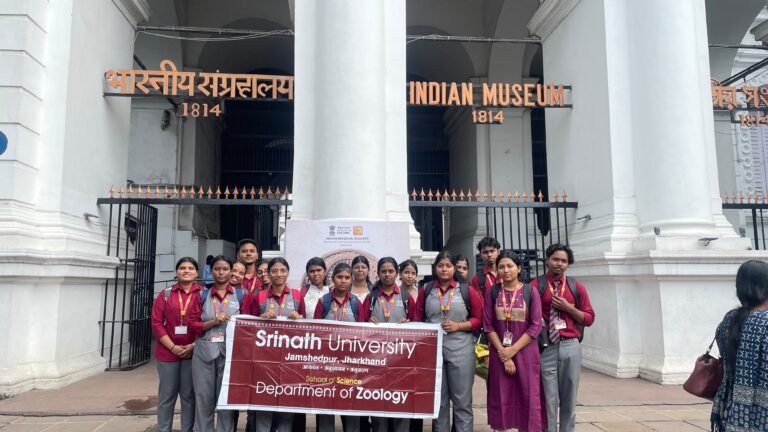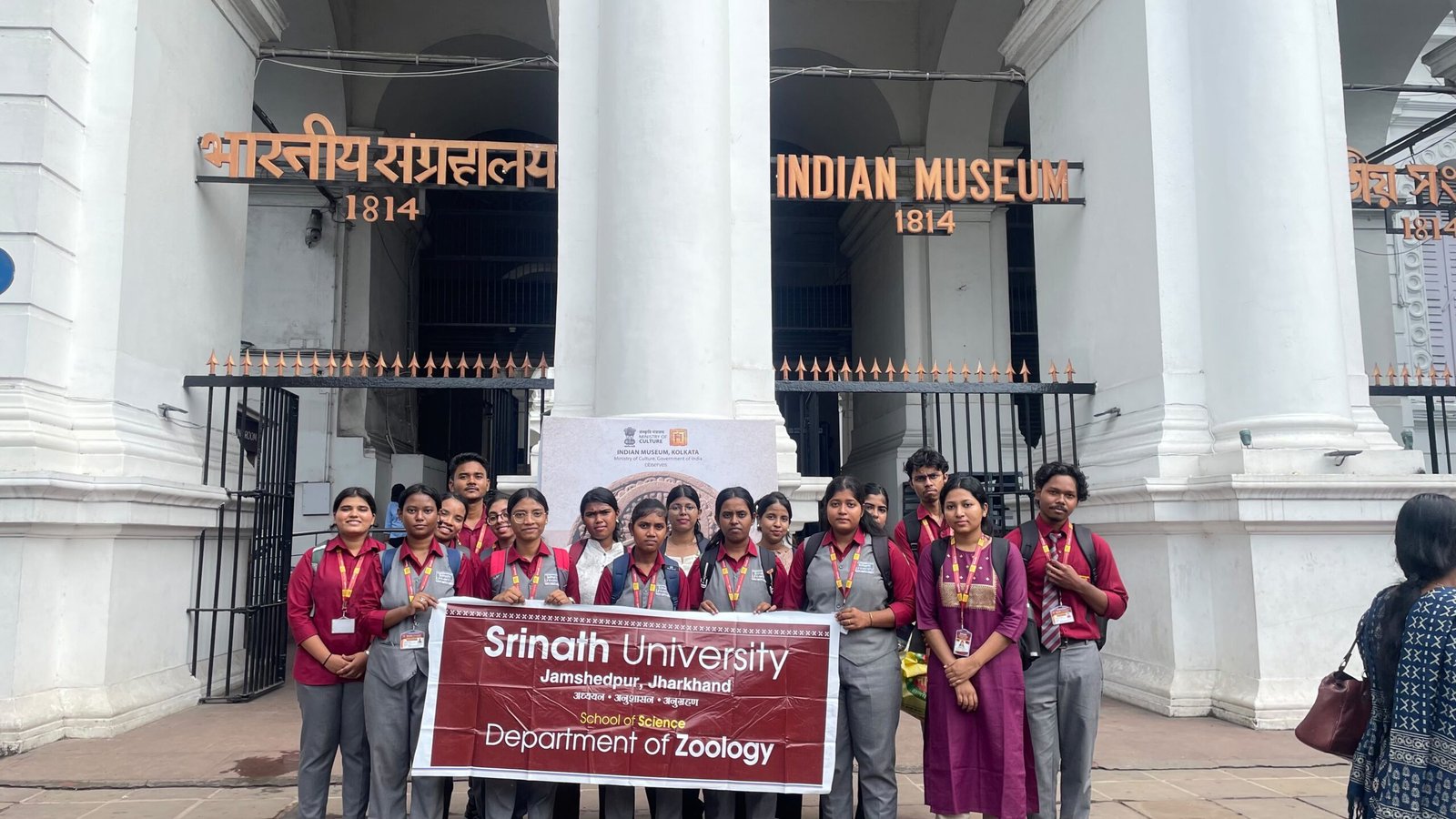
The Department of Zoology, Srinath University, organized an educational tour to the Indian Museum, Kolkata, on October 30, 2026, providing students with an opportunity to explore the rich diversity of life, evolutionary history and scientific heritage.
Recognized as the world’s ninth-oldest museum and India’s largest museum, the Indian Museum houses an extensive collection of biological, archaeological, geological and historical specimens.
During the visit, students explored several galleries, gaining valuable insights into animal diversity, taxonomy, evolution and ecological relationships. The Invertebrate Gallery showcased preserved specimens of insects, crustaceans, molluscs, corals and fossil invertebrates, illustrating the evolution of life across geological periods. The Fish Gallery introduced students to marine and freshwater biodiversity through specimens of seahorses, sawfish and sharks.
The Amphibia and Reptilia Gallery displayed crocodiles, gharials, turtles, snakes and lizards, helping students understand their adaptations and distinctive characteristics. In the Bird Gallery, students observed Indian and exotic bird species, including peacocks, hornbills, flamingos, ostriches and penguins, while learning about variations in beaks, feathers and flight adaptations.
One of the major attractions was the Mammal Gallery, featuring 314 specimens representing 138 species. The collection included the skeleton of an 1804 Minke Whale, the lower jaw of a Blue Whale and the skeleton of an Indian Elephant.
Students also visited the Ecology Gallery, where they explored Indian ecosystems, food chains, ecological interactions and conservation biology. A special attraction was the Egyptian Gallery, which houses a 4,000-year-old Egyptian mummy. Students learned about the ancient mummification process, including the removal of internal organs, dehydration using natron salt, application of resins and oils, and wrapping the body in linen.
The visit also covered the Botany Section, where students observed specimens of medicinal plants, timber, fibres, oils, spices and herbarium collections, gaining insights into the economic and scientific importance of plant resources.
The educational tour provided students with an enriching practical learning experience beyond the classroom. It strengthened their understanding of taxonomy, biodiversity, evolutionary biology, ecology and specimen preservation techniques.
The initiative reflects the Department of Zoology’s commitment to experiential learning and providing students with opportunities to connect theoretical knowledge with real-world scientific observations.
About the Author